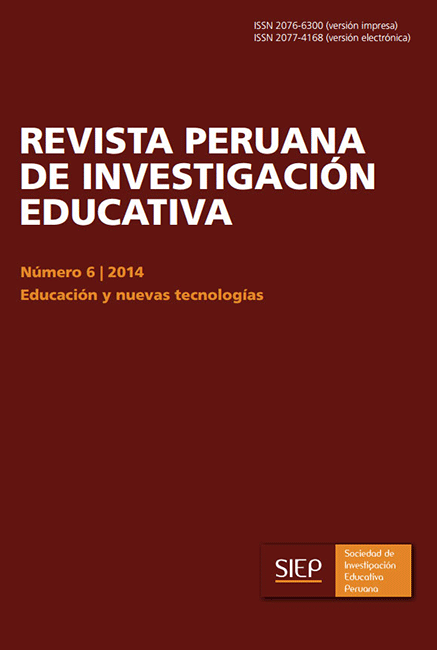
Children, teens and the new technologies: ICT’ access and use in Peruvian schools
DOI:
https://doi.org/10.34236/rpie.v6i6.44Keywords:
children, teens, Information and Comunication Technologies (ICT), educational technologies, PeruAbstract
The intense distribution of educational technologies in Peruvian schools in the last decade along with a greater availability of ICT in the market (thanks to its affordability and greater presence) seems to be changing the technological landscape in Peruvian schools. This paper deals with the question of how this massive presence of ICT is appropriated in the school scenario and what are the students’ perspectives on this. It departs form a recent study in three Peruvian regions, in six different communities, both rural and urban, and carried out in primary and secondary schools. It explores mainly students’ access to ICT and how they use ICT inside and outside schools. Other actors’ (such as teachers and principals) perspectives are also considered to understand and place into context the students’ experiences. The study reveals the precariousness in students’ access to educational technologies, despite their very presence in schools. It also shows the limited use of ICT in students’ learning processes inside and outside schools.
References
Bajak, F. (2012) Peru’s Laptop Effort Gets Mixed Reviews On Its Effectiveness. Education Week, 18 de julio.
Balarin, M. (2013). Las políticas TIC en los sistemas educativos de América La-tina: Caso Perú. Buenos Aires: Unicef.
Barton, D. y Hamilton, M. (1998). Local literacies. Londres: Routledge.
Benitez Larghi, S. y Lemus, M. (2012). Juventud desigualdades y TIC. II Jorna-das de Sociología de la Universidad Nacional de La Plata.
Cristiá, J., Cueto, S., Ibarrarán, P., Santiago, A., Severin, E. (2012). Technology and Child Development: Evidence from the One Laptop per Child Program. IDB Working Paper Series No. IDB-WP-304.
Educación en Red (2014). Laptop Classmate: tecnología para el aprendizaje del siglo XXI. Educación en Red.pe, 9 de mayo de 2014. Recuperado de http://www.educacionenred.pe/noticia/?portada=53441#ixzz3CgIp3nww
Ferrés, J. (2000). Educar en una cultura del espectáculo. Barcelona: Paidós.
García, A., Barreto, M. y Asencio, R. (2013) Control y trasgresión. El uso, apropiación e impacto de las TIC por las mujeres rurales jóvenes en el Perú(Documento de trabajo No. 17 Programa Nuevas Trenzas). Lima: Insti-tuto de Estudios Peruanos.
Gee, J. P. (2004). Situated language and learning: a critique to traditional school-ing. NewYork: Routledge.
Gutiérrez, G. (2009). Uso de las computadoras portátiles XO en el desarrollo de los componentes del área de Comunicación Integral en los alumnos del sexto grado de la I.E. N°30115 del centro poblado Chucupata en Junín (Tesis de Licenciatura en Educación). Pontificia Universidad Católica del Perú, Lima.
Infordata (2008). Entrevista Oscar Becerra II. YouTube, 16 de febrero de 2008.Recuperado de https://www.youtube.com/watch?v=tO2YUIiZk9Q&feature=player_embedded
Kraemer, K., Dedrick, J. y Sharma, P. (2009) One Laptop Per Child: Vision vs. Reality. Communications of the ACM,52 (6). 66-73.
Lapeyre, J. (2014). El espacio pedagógico de las TIC. XV Encuentro Internacio-nal Virtual Educa Perú 2014, Lima, 9-13 de junio.
Laura, C. (2008) Una laptop por niño en escuelas rurales del Perú: Un análisis de las barreras y facilitadores. Lima: CIES.
Martins, L. T. y Castro, L. R. de (2011). Crianças na contemporaneidade: entre as demandas da vida escolar e da sociedade tecnológica. Revista Latino-americanade Ciencias Sociales, Niñez y Juventud, 2 (9), 619 - 634.
Ministerio de Educación (2014). OLPC. Perú Educa. Recuperado de http://www.perueduca.edu.pe/olpc/OLPC_Dist.html
Pedró, F. (2012) Tecnología y escuela: lo que funciona y por qué. Lima: Fun-dación Santillana.
Prensky, M. (2001). Digital Natives, Digital Immigrants. On the Horizon, MCB University Press, 9 (5).
Trinidad, R. (2005) Entre la ilusión y la realidad: las nuevas tecnologías en dos proyectos educativos del Estado. Lima: Instituto de Estudios Peruanos.
Trinidad, R. y Rodrígues, H. (2012) Investigación comparativa sobre los usos y disfrute de Internet por niños y niñas de entre 8 y 10 años, en tres colegios de Argentina, Perú y Paraguay. Lima: Save the Children Suecia.
Santiago, A., Severin, E., Cristia, J., Ibarrarán, P., Thompson, J. y Cueto, S. (2010) Evaluación experimental del programa Una Laptop por Niño en Perú. Aportes, División de Educación del Banco Interamericano de Desa-rrollo, julio, (5).
Street, B. (1993). Cross-cultural approaches to literacy. Cambridge: Cambridge University Press.
---------- (1995). Social Literacies: Critical Approaches to literacy in ethnogra-phy and development. New York: Longman.
---------- (2000). Literacy events and literacy practices: Theory and practice in the New Literacy Studies. En Jones, K. y Martin-Jones, M. (Eds.), Multilin-gual Literacies. Reading and writing different worlds (17–29). Philadelphia: John Benjamins Publishing Company.
Street, B. y Street, J. (2004). La escolarización de la literacidad. En Zavala, V., Niño-Murcia, M. y Ames, P. (Ed.), Escritura y Sociedad: nuevas perspec-tivas teóricas y etnográficas. Lima: Red para el Desarrollo de las Ciencias Sociales.
Unwin, T. (2014) The damaging mythology of «Digital Natives». Uniwin. Re-cuperado de http://unwin.wordpress.com/2014/08/10/the-damaging-my-thology-of-digital-natives/
Villanueva, E. y Olivera, P. (2012). Barreras Institucionales para el Desarrollo de una Innovación: Evaluando la Implementación de las Computadoras XO-1 en dos Escuelas Periurbanas del Perú. Information Technologies & International Development [Edición Especial Bilingüe: Investigación sobre TIC4D en Latinoamérica],8 (4), 191-203.
Warschauer, M. y Ames, M. (2010) Can one laptop per child save the world ́s poor? Journal of International Affairs. Fall/Winter 2010, 64 (1). New York, The Trustees of Columbia University.
Downloads
Published
Issue
Section
License
Copyright (c) 2014 Revista Peruana de Investigación Educativa

This work is licensed under a Creative Commons Attribution-NonCommercial-NoDerivatives 4.0 International License.